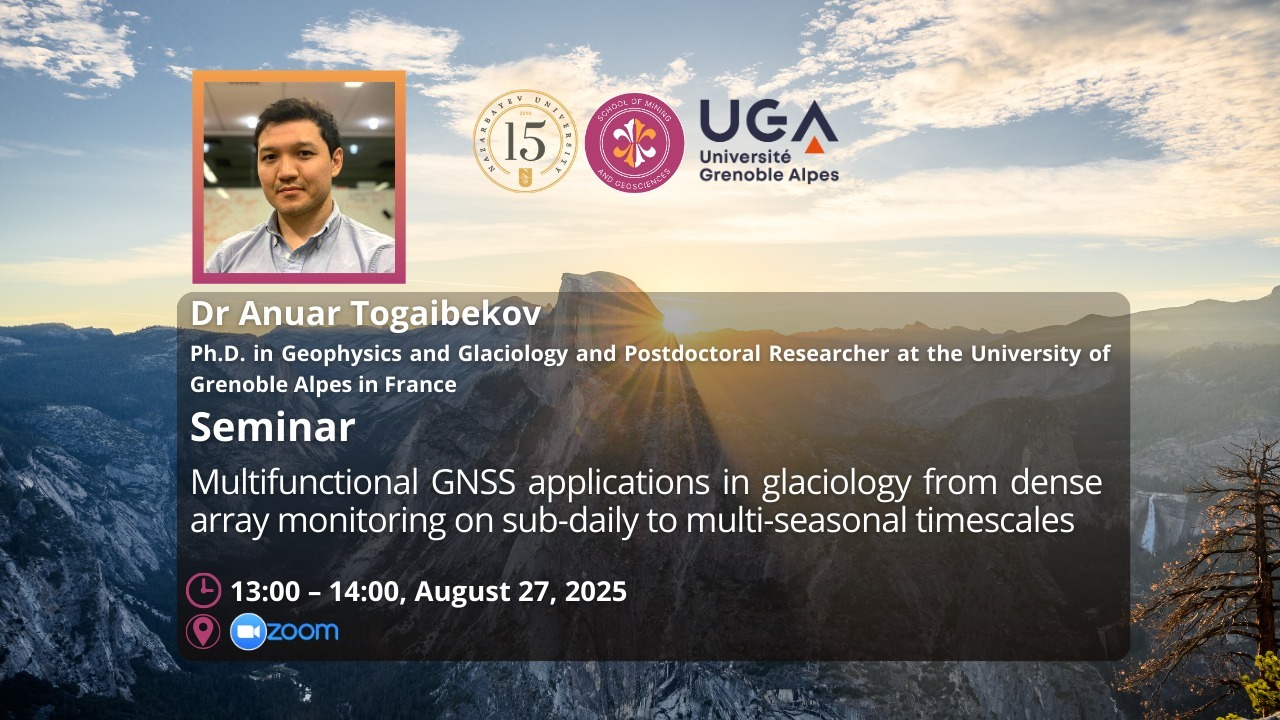
Date: 27 August 2025
Time: 13:00–14:00
Venue: Block 6, Room 6302
Speaker: Dr. Anuar Togaibekov, Postdoctoral Researcher, University of Grenoble Alpes (France)
Time: 13:00–14:00
Venue: Block 6, Room 6302
Speaker: Dr. Anuar Togaibekov, Postdoctoral Researcher, University of Grenoble Alpes (France)
Overview
The School of Mining and Geosciences at Nazarbayev University invites you to a guest seminar by Dr. Anuar Togaibekov, an expert in glaciology and geophysics, who will present his research on how Global Navigation Satellite Systems (GNSS) can be used as high-resolution tools for glacier monitoring across multiple timescales.
The seminar will focus on how GNSS data, when collected through a dense array, can unveil the hidden dynamics of glacier flow—including basal sliding, uplift, and mass balance variations. The insights gained from such observations are critical for improving global models of sea level rise, a key concern in the context of climate change.
About the Talk
Glaciers are powerful but sensitive indicators of climate variability. A large part of glacier mass loss comes not just from melting but from the movement of ice—a process governed by complex basal interactions such as sliding and deformation. Despite its significance, the friction processes beneath glaciers remain poorly understood.
In this seminar, Dr. Togaibekov will present findings from a three-year GNSS monitoring campaign at the Glacier d’Argentière in the French Alps. The dense GNSS network was deployed to track 3D surface velocities at high temporal resolution (sub-daily to seasonal) and linked to subsurface processes through an integrated hydro-mechanical model.
Key objectives of the study include:
- Distinguishing between creep deformation, basal sliding, fracturing, and uplift.
- Quantitatively linking surface velocity variations to changes in basal friction and water pressure.
- Exploring the potential of GNSS to monitor surface mass balance over time.
The seminar will offer valuable insights for students and researchers in geophysics, remote sensing, civil engineering, climate science, and environmental monitoring.
Speaker Bio
Dr. Anuar Togaibekov is a postdoctoral researcher at the University of Grenoble Alpes, where he is currently investigating the ice shelf dynamics of the Astrolabe Glacier in Antarctica. His doctoral research focused on glacier sliding and mass balance processes in alpine environments.
He holds a PhD in geophysics and glaciology from the University of Grenoble Alpes and a master’s degree in geophysics and seismology from the Massachusetts Institute of Technology (MIT). His previous work included research on induced seismicity related to oil and gas production and participation in a carbon capture and storage project with ExxonMobil at the National University of Singapore (NUS). Dr. Togaibekov also has hands-on experience in the oil and gas industry as a practicing geophysicist.