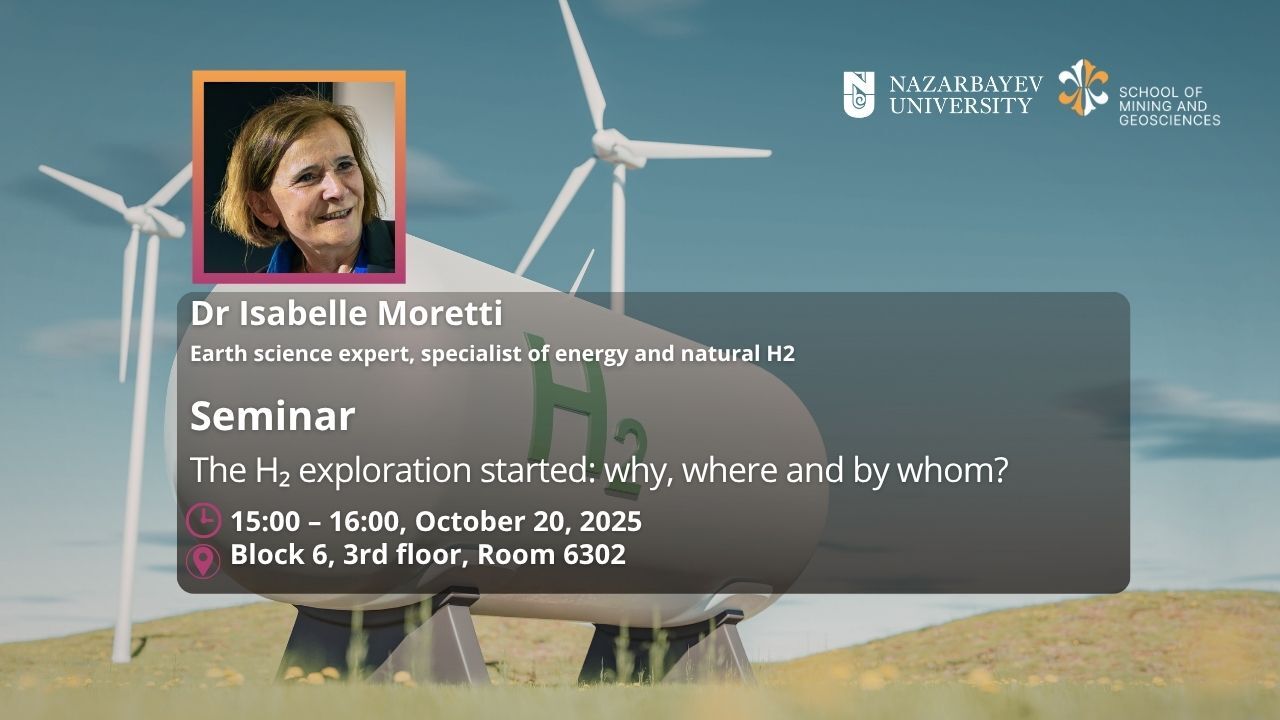
Date & time: Monday, 20 October 2025, 15:00–16:00
Venue: Block 6, 3rd floor, Room 6302
Format: Seminar
Speaker
Dr. Isabelle Moretti — Earth science expert and specialist in natural hydrogen exploration; researcher at Université de Pau et des Pays de l’Adour (UPPA) and Sorbonne University; former Chief Scientific Officer at Engie; co-author of 160+ peer-reviewed publications; elected member of the French Academy of Technology (Vice President, Energy Pole).
Abstract
The existence of H₂ emanations from subsurface has been known for a long time but, until recently, this was not seen as a potential primary energy source. The landscape has changed since low-carbon and low-cost H₂ is increasingly sought after. After fortuitous discoveries, such as took place in Mali, exploration started in various countries. Hydrogen is always present in the subsurface, but it is usually combined, such as in water (H₂O) or hydrocarbons (CnH₂n+2); however, in various contexts it could also be present as a free gas. Oxidoreduction, radiolysis, and late maturation of the organic matter are the main reactions that generate H₂. Australia and the USA are the most active countries in exploration; in Europe, France, as well as Spain, Poland and Kosovo, among others, already delivered exploration permits. Resources are now proven to be huge but reserves still need to be discovered. Let’s take a look at efforts in this direction around the world.